Mar
07
Posted by jns on 7 March 2012
I read a lot of popular-science books. You know I do this partly to support the Science Booknotes and Science Book Challenge projects at Scienticity. I often remark to myself how thoroughly I enjoyed a book that I chose arbitrarily at my library, maybe because the title appealed to me or the book spine was the right color for me that evening. The implication for me, I’m happy to say, is that there is a great deal of really very good writing about science for the non-specialist. It’s satisfying to review these books and let other potential readers know about the great ideas they discuss.
Sometimes, of course, I select a book that turns out not to suit my taste for some reason. Generally speaking I prefer not to review a book I didn’t care for because I don’t see the point of a negative review about a book whose subject matter didn’t really appeal to me or whose author wrote in a style that I found unsympathetic. After all, many others might find the book worthwhile or tune in to that author’s particular style, and I’d much rather have a review in our booknotes collection setting out positive reason why a potential reader might choose to read a particular title.
Then there is the small but difficult category of books that I never finish reading because, for some reason or another, I find them too overwhelmingly irritating. For instance, I never finished reading Stephen Jay Gould’s The Hedgehog, the Fox, and the Magister’s Pox (my booknote) because his writing was so bad, and so badly edited, that I conjectured that it had been written by pod people who had taken over his body. Happily, these are rare events, but sometimes it seems important to write about them.
What to do, then, when I find an author known for his (or her) enthusiastic and entertaining advocacy and popularizing for science whose writing exhibits a notable disregard for precision about scientific facts and, furthermore, who seems to have a superficial or incorrect understanding of parts of his or her subject matter?
When I read a book that I plan to write about, I keep a folded sheet of paper inside the back cover where I make notes of interesting ideas, things to mention, and possible quotations for use in a review. I also make a note of trouble spots in the text: unclear or badly written explanations, confusion over facts of science, and such things. When I have filled the pages with errors the author has made and I’m only on page 30 of the book, I know I have trouble on my hands, and a quandary. I can easily stop reading the book, but I have to decide whether to write about it or not. Is there a useful point — beyond venting my spleen — to writing about bad science writing?
I have such a case on hand with Michio Kaku’s Physics of the Impossible*, in which the (apprently) well-known science popularizer talks about the physics and possibility of such science-fiction staples as invisibility cloaks, force fields, time travel, and such topics. It’s a very appealing idea, I thought, but I had to stop reading; there were simply too many errors–some serious errors–of science to continue, all before I reached page 30, less than one-tenth of my way through the book.
Let’s begin by going through some of the problems that I had in these early pages.
1. Conflating Historic Events
“Growing up, I remember my teacher one day walking up to the map of the Earth on the wall and pointing out the coastlines of South America and Africa. Wasn’t it an odd coincidence, she said, that the two coastlines fit together, almost like a jigsaw puzzle? Some scientists, she said, speculated that perhaps they were once part of the same, vast continent. But that was silly. [...] Later that year we studied the dinosaurs. Wasn’t it strange, our teacher told us, that the dinosaurs dominated the Earth for millions of years, and then one day they all vanished? No one knew why they had all died off. Some paleontologists thought that maybe a meteor from space had killed them, but that was impossible; more in the realm of science fiction [pp. xi--xii]
The idea that the continents might once have fitted together is a very old one, evident to most anyone who ever looked at a world map. These days we have at hand the well-established theory of plate techtonics to explain how it all could have happened, and certainly did happen. In the earlier twentieth century geologists and others began thinking more seriously about the idea of continents moving, but it was experimental results in the late 1950s and early 1960s that finally overthrew “conventional wisdom” that the continents couldn’t just move around. Plate techtonics was well established as scientific orthodoxy by 1965.
The Alvarez Theory, the idea that the extinction of the dinosaurs was brought about by the impact with Earth of a large body from space, was first proposed by Luis and his son Walter Alvarez following on Walter’s discovery of a thin sedimentary layer of iridium that dated closely to the time when dinosaurs disappeared. That theory did not appear until 1980. For many years afterwards the idea that an asteroid impact wiped out the dinosaurs was widely thought preposterous; before that time it hadn’t even been thought of. By now, of course, it’s widely familiar to the general public.
I hope you see my difficulty by now. The author writes that his teacher taught him that 1) some scientists speculated that continents drifted, an assertion that only makes sense prior to 1965, when Plate Techtonics was established; and 2) that some scientists though maybe an asteroid had killed the dinosaurs, an idea that no one had thought of until 1980. He writes that his teacher taught him these things in the same year, even though the closest in actual time that they may have come to each other is 15 years. In other words, this makes a good story but it’s highly unlikely that these two events took place in the same year.
2. Confusing Words and Ideas
This problem is more subtle. In the first chapter Kaku has a section on “force fields”, a common technology of science-fiction worlds for decades. Kaku unfortunately takes the words too literally and conflates the notion of a science-fiction “force field” with some combination of the ideas of “forces” and “fields” as they are used in physics, and so he spends some time talking about the four fundamental forces of the universe (gravitation, electromagnetism, the weak force, and the strong force) and discusses to some extent how each of these is formulated mathematically as “field theories”. But one does not get “force fields” by simply combining these two concepts. He confuses the reader over these pairs of words used differently in two different realms, and then leaves the reader with the mistaken impression that “force fields” might become reality just as soon as physics catches up and discovers a new field theory for a “fifth force”. None of this has anything useful to do with the concept of a “force field” as it’s deployed by science-fiction authors.
3. Casual Writing Leads to Mistaken Readings
In another space I’ll write about what I think should be the prime directive of any writer about science : First, Do Not Mislead. Writing about science for a popular audience is an awesome responsibility; scientifically literate readers can fend for themselves, but if the author has in mind an audience of nonspecialists, it is vital that the author take the utmost care with describing and explaining facts from science, because the nonspecialist reader can easily invent his or her own mistaken notion of how nature works when presented with sloppy, incomplete, or imprecise exposition. I expect popular science writers to
- Get it right, and
- Say it clearly.
Here are just some examples of statements that I felt violated the Prime Directive in Kaku’s writing. First, from the section on “Magnetic Levitation”:
“One common property of superconductivity is called the Meissner effect.” [p. 14]
When a superconductor in a magnetic field is cooled from its normal (non-superconducting) phrase to its superconducting phrase, it “expels” the external magnetic field from it’s interior, which is to say that it creates on its surface electrical currents that themselves create a magnetic field that just cancels the externally imposed field within the superconductor. This is known as the “Meissner Effect”, named for Walther Meissner. This is a defining characteristic of superconductors, a property necessarily exhibited by every superconductor. I find it odd to refer to it as a “common property of superconductivity”, as though it’s an incidental property seen in only some, perhaps many, superconductors, but suggesting that it is not a universal property.
In a section on “Invisibility”, discussing the possibility of an “invisibility cloak”:
“But today the impossible may become possible. New advances in “metamaterials” are forcing a major revision of optics textbooks. [p. 17]
Actually, the manufactured metamaterials that Kaku refers to, surprising and ingenious as they are, behave according to well-understood principles, requiring no “revision”, just an increase in understanding how to manufacture materials with desirable optical properties. This is misleading and a type of sensationalism that doesn’t serve the cause of increasing science literacy.
Later in the section on “Invisibility”, Kaku turns to a discussion of electromagnetic fields, namely, James Maxwell’s great advance in physical theory in the 19th century:
“(…If he [Maxwell] had lived longer, he might have discovered that his equations allowed for distortions of space-time that would lead directly to Einstein’s relativity theory. [p. 19]
Now, here is a frequent problem with those who write about science. There are, in fact, two distinct theories of Einstein commonly referred to as “relativity” : the theory of “Special Relativity”, from 1905, and the theory of “General Relativity”, from 1916. Special relativity is a theory of electrodynamics, basically a theory of light, which also introduced the idea of four-dimensional “space-time” and that most famous of equations, E=mc^2. General relativity is a theory of gravitation, a geometrical theory that treats gravity as deformations in space-time.
Usually the context makes clear which “relativity” the author meant. But here our only guide is that Kaku speaks of “distortions of space-time”. In special relativity travel at high velocities bring about time dilations and length contractions (“Lorentz Transformations”), i.e., distortions of space-time. In general relativity, gravitational effects are produced by the distortions of space-time caused by mass.
Carelessness here has caused a confusion that can’t be untangled and therefore does nothing to enlighten the nonspecialist reader who may not distinguish the two “relativity” theories so easily to begin with.
4. Errors of Physical Fact
These were the most troubling errors that confronted me in reading the first sections of Kaku’s book. Troubling because it betrays the trust between the nonspecialist reader and the authoritative voice of the author to make statement of physical fact, or to give descriptions of physical systems, that are imprecise or simply incorrect. I find it even more troubling when the author is a physicist who should be expected to get it right.
Back to the pages of discussion about Maxwell’s Theory of Electrodynamics, the author writes:
Maxwell began with Faraday’s discovery that electric fields could turn into magnetic fields and vice versa. He took Faraday’s depictions of force fields and rewrote them in the precise language of differential equations, producing one of the most important series of equations in modern science. They are a series of eight fierce-looking differential equations. Every physicist and engineer in the world has to sweat over them when mastering electromagnetism in graduate school [p. 18].
While it is certainly true that every physicist and engineer had to sweat over the equations in graduate school–probably even using the same, nearly universally taught textbook–the italicized phrase (my italics) would raise any student’s eyebrows. Whether the equations are “fierce-looking” or not is a matter of taste (I think they’re rather elegantly simple myself), there are in fact only four equations, two for the electric field and two for the magnetic field.
I nearly dropped the book when I read this — I couldn’t imagine how any physicist could have come to refer to “eight” equations. Now, while it’s true that the electric and magnetic fields are written in modified form when they occur in materials, rather than vacuum, the equations stay the same. That there are two each for the electric and magnetic fields is fundamentally characteristic of the entire field theory.
Slightly further on, Kaku offers this analysis of the property of optical transparency in materials:
Maxwell’s theory of light and the atomic theory give simple explanations for optics and invisibility. In a solid, the atoms are tightly packed, while in a liquid or gas the molecules are spaced much farther apart. Most solids are opaque because light rays cannot pass through the dense matrix of atoms in a solid, which act like a brick wall. Many liquids and gases, by contrast, are transparent because light can pass more readily between the large spaces between their atoms, a space that is larger than the wavelength of visible light. For example, water, alcohol, ammonia, acetone, hydrogen peroxide, gasoline, and so forth are all transparent, as are gases such as oxygen, hydrogen, nitrogen, carbon dioxide, methane, and so on.
There are some important exceptions to this rule. Many crystals are both solid and transparent. But the atoms of a crystal are arranged in a precise lattice structure, stacked in regular rows, with regular spacing between them. Hence there are many pathways that a light beam may take through a crystalline lattice. Therefore, although a crystal is as tightly packed as any solid, light can still work its way through the crystal.
Under certain circumstances, a solid object may become transparent if the atoms are arranged randomly [as in a glass]. [pp. 25--26]
It’s at this point that I threw up my metaphorical hands in despair and stopped reading the book. This “explanation” of transparency is so totally wrong I hardly know where to begin.
Light, namely, propagating electromagnetic waves, only interact with matter via the electromagnetic field (with a notable exception in General Relativity that doesn’t impinge on this discussion); in other words, light waves are sensitive to electrical charges, electrical currents, and magnetic fields. They sense the electrical charge of the electron “cloud” around an atomic nucleus; they might sense the positive charge of protons in a nucleus if they can get close enough for it to have an effect. Electromagnetic waves–light waves or photons, pick your favorite representation–do not interact with the mass of matter itself. Whether atoms are heavy or not heavy makes no difference, the light doesn’t sense the mass. Hold that thought.
Now, while it is true that the atoms in a liquid or solid are much closer together than they are in a gas, the atoms are still so physically small and so distantly separated relative to their physical sizes–not to mention that the components of an atom are vastly tinier than the “size” of the atom itself–that most of matter, whether solid, liquid, or gas, is still empty space. Even in a crystal or a glass this is true. Physically, the mass of atoms occupies exceedingly little of the space of the object they make up. By “exceedingly little” I mean this: the volume of the atomic nucleus is only about 1/1,000,000,000,000th the approximate volume of the atom itself.
I hope it’s becoming clear by this point that how close the atoms are together has relatively little bearing on how much “space” in matter is taken up by substantial parts of the atoms. The simple deduction, then, is that material objects are not more transparent or less transparent because the atoms are closer or further apart such that they “block” the light. The light does not run into the atoms and get blocked by their physical size. They are in no sense like a “brick wall” in any way that I can imagine makes sense.
The transparency of any given substance is determined by the not-so-simple interaction between light waves of particular frequencies (or “colors”) and the electric fields (predominantly) created in the substance by the particular configuration of its atoms. Gases do tend to be relatively transparent because the wide separation of their atoms creates a weakly interacting electric field. Nevertheless, some gasses do have colors because their atoms absorb certain wavelengths of light preferentially, through light waves being absorbed and/or emitted by the atomic electrons. Crystals have complicated and varied optical properties — transparency, opacity, colors in gemstones, birefringence, polarization rotations, etc. — depending sensitively on the periodically varying electric field inside the crystal that is produced by the regular (crystalline) placement of the atoms; but do keep your mind on the electric field inside the crystal, not the atoms “blocking” the light. There are also materials that are mostly opaque to visible light but that can be transparent in wavelengths of light that our eyes do not detect. The optical properties of materials is a rich field with lots of interesting effects and phenomena; get a taste for it, if you like, by looking up “transparency” in Wikipedia.
Looking up “transparency” is apparently something that author Kaku didn’t bother to do when he should have. His explanation of the phenomenon I find so confused and misleading that I feel his writing does a serious disservice to the nonspecialist who reads his book hoping for understanding from a scientist who knows what he’s talking about. This is why I stopped reading the book at this point, and why I have chosen to write about it.
One or two of the objections I noted earlier on amount to very little. I frequently find one or two little errors in any book I read, but it’s usually just something to note with some amusement and then move on; rarely does a misstatement or error like that cause me serious concern, and I rarely comment on them in my review of a book. A whole string of them, page after page, however, convinces me that the author is a sloppy writer or has a very superficial knowledge of the subject at hand. When the writer is a working scientist writing about science, I am totally confounded. As for these bigger errors I’ve just discussed — they are inexplicable. It is the author’s responsibility to realize the limits of his or her knowledge or understanding and find ways to avoid or correct problems in his or her writing.
These are the reasons why I simply cannot recommend this book to a general reader. That the book seems to have reached some level of popularity disturbs me : such poorly conceived and executed writing about science undermines the efforts of the many excellent writers about science — scientists, historians, journalists, and others — writing with more care and accuracy about their subject.
———-
* Michio Kaku, Physics of the impossible : a scientific exploration into the world of phasers, force fields, teleportation, and time travel. New York : Doubleday, 2008. xxi + 329 pages.
Sep
14
Posted by jns on 14 September 2011
You may recall my mentioning Scienticity’s “Eye for Science” project, a Flickr group to which members contribute interesting and provocative images that tell a story about science or nature or something related, which images we then try to get in front of others to provide a brief science moment. One way we do this is through a widget that shows a clickable thumbnail of the image; you can see it in action right there on the right of this blog page (or the left, if I’ve redesigned the theme). Every time the page is reloaded, a different image, chosen randomly from the group, shows up. At the time of my writing this the project has been going for a little over two years and the group has 97 members who’ve contributed 994 images. Why not consider joining us?
Ever since smartphones started to appear I’ve wanted to have an “Eye for Science” app that would serve up a random image from the collection whenever the user accessed the app. But, I’ve never taken the time to learn how to program in the necessary way to create such an app. Very recently I upgraded my own phone to something “smart”, an Android model as it turns out, and the thought crossed my mind again, and I made a happy discovery : no programming required!
Well, nearly. Which is to say that I could accomplish the best part of what I wanted with tools that existed on my phone, without writing an app. What I decided I wanted one afternoon was to use an eye-for-science image for my phone’s wallpaper and be able to change it easily whenever the whim arrived to do so, maybe every day (or more often). I did have to do a little behind-the-scenes programming with the Scienticity-hosted webpage that accesses the Flickr database, but that I knew how to do.
So, here’s how I have a pseudo-app–a bookmark, actually–on my Android home page that let’s me view a random sciency image and make it my wallpaper.
I used the “web” app (browser) to access the url, http://scienticity.net/efsm/ ; you can do this in your regular browser, too, there’s nothing magical about it. Accessing this URL returns a random, full-sized image from the Flickr database, along with the title and caption, the same thing you’d get by clicking the thumbnail in the widget on this page.
Once I have this page in my browser I can make a bookmark (“menu / more / add shortcut to home”) on my home screen. From my home screen, then, touching the bookmark opens this URL in my browser with a new random image. If I’m already looking at an image page I can get a new image, randomly selected, by touching “menu / refresh”, because each time I access the URL I get a new random image. Then, I can keep trying images (and enjoying what I see) until I get to one that strikes me as something that will make good wallpaper.
Then — on my phone at least — all I have to do is touch the image on my screen and hold my finger there until I get a menu of options, one of which is “set as wallpaper”. I touch that option and I have new wallpaper!
I’m a little embarrassed to say how inordinately pleased I am to be able to set my wallpaper so easily to new eye-for-science images whenever I feel moved to do so, but there you go.
Please, I invite you to give it a try, It’s quick, it’s easy, and you’ll see interesting things that might make you think “hunh”, which is the goal of the project. Have fun!
Sep
27
Posted by jns on 27 September 2010
Well, how nice. Our area of the country, greater Washington DC, has been acclaimed by The Weather Channel as having had the worst summer of any major area in the US in 2010 (Jon Erdman, Tim Ballisty and Chris Dolce, “Top 5 Worst Summers“, not dated/accessed 24 September 2010). There are several extreme conditions, like storms and drought, that were part of their judgement, but heat was a big factor, of course. The big factor was the one that I noticed myself, namely the number of days when the high temperature was over 90 F.
I had the impression, as early as the beginning of July, that we were having an unusual number of days at a time with temperatures over 90 F. That obviously led to the question of whether my impression was correct that, in my memory, we rarely had more than, say, two days in a row so hot, maybe one week a summer with each day so hot, but not endless strings of days over 90 F and close to, if not exceeding, 100 F. (That latter only happened on about three days, which is more typical.)
Phew, I wasn’t just imagining it:
The summer of 2010 was a scorcher in many parts of the world, including the eastern U.S., where Washington, D.C. and New York, N.Y. broke records for their warmest summer since recordkeeping began. According to the Washington Post’s “Capital Weather Gang” blog, (full discosure: I write a weekly climate science column for that site) this year marked the first time that city has experienced an average summer high temperature that was greater than 90 degrees Fahrenheit. Temperatures in D.C. reached or exceeded the 90 degree threshold on 52 days during June, July, and August, which together comprise the meteorological summer months. The average low temperature this summer was also far above average in D.C., with 71 days having had a low temperature of 70 degrees or higher, the Post reported.
[Andrew Freedman, "Warmest Summer on Record for DC and New York", Climate Central, 1 September 2010.]
Now, there are interesting questions we might consider about just what it means to say this was our “hottest” summer. Average high temperatures, average low temperatures, number of days above a certain temperature, and others. These are derive, really, from the idea that it’s very hard to describe a statistical population with a single statistic, like an “average”, although that rarely impedes our attempts to do so.
But number of days over 90 F is useful (similar to a median measurement) and it was certainly noticeable to me. Any temperature in the 70s seems mostly comfortable to me, the 80s generally feel “warm” to me, but cross 90 F and the air feels “hot” to me. The good part, I suppose, is that once it’s “hot” I wilt but it doesn’t much matter to me whether it’s 95 F or 105 F.
Here’s another interesting way to look at this idea of “hotter summer”. This graph takes each day’s “average temperature” (itself a slippery concept) [source] against a 30-year average and reporting the difference, showing us that most days were notably hotter than “average”:
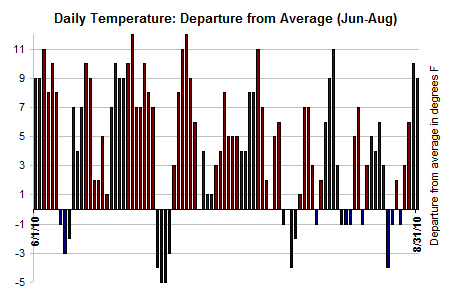
It doesn’t provide relief from the heat, but I get some sense of vindication out of it.
Sep
15
Posted by jns on 15 September 2010
Someplace in my reading recently I happened upon the “memorandum opinion” in McLean v. Arkansas Board of Education (1982). My attention was drawn to it because of a remark about how it “defined science”. Well, I wouldn’t go so far as “defined” although the characteristics of the scientific enterprise are outlined, and that may have been a first for American jurisprudence (but I haven’t made a study of that history yet).
Judge William R. Overton summarizes the case succinctly in his introduction:
On March 19, 1981, the Governor of Arkansas signed into law Act 590 of 1981, entitled “Balanced Treatment for Creation-Science and Evolution-Science Act.” The Act is codified as Ark. Stat. Ann. &80-1663, et seq., (1981 Supp.). Its essential mandate is stated in its first sentence: “Public schools within this State shall give balanced treatment to creation-science and to evolution-science.” On May 27, 1981, this suit was filed (1) challenging the constitutional validity of Act 590 on three distinct grounds.
[source]
The grounds were 1) that it violated the establishment clause of the First Amendment to the US Constitution; 2) that it violates a right to academic freedom guaranteed by the First Amendment; and 3) that it is impermissibly vague and thereby violates the Due Process Clause of the Fourteenth Amendment.
The judge ruled in favor of plaintiffs, enjoining the Arkansas school board “from implementing in any manner Act 590 of the Acts of Arkansas of 1981″. So, there is where so-called “scientific creationism” was pushed back out of the scientific classrooms, and the reason creationists began–yet again–with rebranding and remarketing creationism, this time as “intelligent-design” creationism, to try to wedge it back into the scientific curriculum.
The opinion is refreshingly brief and to the point. It’s difficult to avoid the impulse simply to quote the whole thing.
In his discussion of the strictures of the “Establishment of Religion” clause, Judge Overton quotes from opinions by Supreme-Court Justices Black and Frankfurter
The “establishment of religion” clause of the First Amendment means at least this: Neither a state nor the Federal Government can set up a church. Neither can pass laws which aid one religion, aid all religions, or prefer one religion over another. Neither can force nor influence a person to go to or to remain away from church against his will or force him to profess a belief or disbelief in any religion. No person can be punished for entertaining or professing religious beliefs or disbeliefs, for church-attendance or non-attendance. No tax, large or small, can be levied to support any religious activities or institutions, whatever they may be called, or what ever form they may adopt to teach or practice religion. Neither a state nor the Federal Government can, openly or secretly, participate in the affairs of any religious organizations or groups and vice versa. In the words of Jefferson, the clause … was intended to erect “a wall of separation between church and State.”
[Justice Black, Everson v. Board of Education (1947)]
Designed to serves as perhaps the most powerful agency for promoting cohesion among a heterogeneous democratic people, the public school must keep scrupulously free from entanglement in the strife of sects. The preservation of the community from divisive conflicts, of Government from irreconcilable pressures by religious groups, or religion from censorship and coercion however subtly exercised, requires strict confinement of the State to instruction other than religious, leaving to the individual’s church and home, indoctrination in the faith of his choice. [Justice Frankfurter, McCollum v. Board of Education (1948)]
The phrases that jump out at me are “means at least this” and ” the public school must keep scrupulously free from entanglement in the strife of sects”. He also quotes Justice Clark (Abbington School District v. Schempp (1963)) as saying “[s]urely the place of the Bible as an instrument of religion cannot be gainsaid.”
Put them together and it’s quite clear, as Judge Overton wrote, that “[t]here is no controversy over the legal standards under which the Establishment Clause portion of this case must be judged.” Of course, this doesn’t keep certain christianist sects from repeatedly trying to assert that their version of a holy book is somehow an American historical and cultural book and not an “instrument of religion”. To the objective observer, of course, those repeated attempts merely underscore the importance and continuing relevance of vigilance in keeping schools “scrupulously free from entanglement in the strife of sects”.
Judge Overton begins section II this way:
The religious movement known as Fundamentalism began in nineteenth century America as part of evangelical Protestantism’s response to social changes, new religious thought and Darwinism. Fundamentalists viewed these developments as attacks on the Bible and as responsible for a decline in traditional values.
He continues with more brief historical notes about “Fundamentalism” (NB. his remark that it traces its roots to the nineteenth century) and its renewed concerns with each passing generation that America is finally succumbing to secularism and its civilization is at last crumbling, paralleling the conviction of millennialists that their longed for second coming of Jesus is forever imminent. Perhaps needless to say, since I am a scientist, I’d like to see predictions about the second coming and the end of civilization given a time limit so that, when said events fail to materialize in the required time, we can consider the parent theories to be disproven.
In particular he notes that fundamentalist fever was pervasive enough that teaching evolution was uncommon in schools from the 1920s to the 1960s; sentiment and practice only changed as a response to Sputnik anxiety in the early 1960s, when curricula were revamped to emphasize science and mathematics. In response, the concepts of “creation science” and “scientific creationism” were invented as a way to repackage the usual anti-evolution ideas. As Judge Overton says
Creationists have adopted the view of Fundamentalists generally that there are only two positions with respect to the origins of the earth and life: belief in the inerrancy of the Genesis story of creation and of a worldwide flood as fact, or a belief in what they call evolution.
It’s a false dichotomy, of course, but is an idea heavily promoted (usually implicitly) by modern creationists. Of course, it’s a double edged sword: when creationists work so hard to instill the idea that it can only be creationism or Darwinism, they are perceived as losing big when creationism is, yet again, crossed off as a viable “science” option by the courts.
In the remainder of this section Judge Overton examines in some detail the testimony and evidence of “Paul Ellwanger, a respiratory therapist who is trained in neither law nor science.” It’s revealing stuff, demonstrating that “Ellwanger’s correspondence on the subject shows an awareness that Act 590 is a religious crusade, coupled with a desire to conceal this fact.” It’s an arrogance on the part of creationists that we’ve seen over and over again, his recommending caution in avoiding any linkage between creationism and religion and yet continually using rhetoric about Darwinism as the work of Satan. There’s more that I won’t detail here. His conclusion for this section:
It was simply and purely an effort to introduce the Biblical version of creation into the public school curricula. The only inference which can be drawn from these circumstances is that the Act was passed with the specific purpose by the General Assembly of advancing religion.
In a nice rhetorical flourish, Judge Overton echoes this conclusion in the opening of section III:
If the defendants are correct and the Court is limited to an examination of the language of the Act, the evidence is overwhelming that both the purpose and effect of Act 590 is the advancement of religion in the public schools.
Section 4 of the Act provides:
Definitions, as used in this Act:
- (a) “Creation-science” means the scientific evidences for creation and inferences from those scientific evidences. Creation-science includes the scientific evidences and related inferences that indicate: (1) Sudden creation of the universe, energy, and life from nothing; (2) The insufficiency of mutation and natural selection in bringing about development of all living kinds from a single organism; (3) Changes only within fixed limits of originally created kinds of plants and animals; (4) Separate ancestry for man and apes; (5) Explanation of the earth’s geology by catastrophism, including the occurrence of a worldwide flood; and (6) A relatively recent inception of the earth and living kinds.
- (b) “Evolution-science” means the scientific evidences for evolution and inferences from those scientific evidences. Evolution-science includes the scientific evidences and related inferences that indicate: (1) Emergence by naturalistic processes of the universe from disordered matter and emergence of life from nonlife; (2) The sufficiency of mutation and natural selection in bringing about development of present living kinds from simple earlier kinds; (3) Emergence by mutation and natural selection of present living kinds from simple earlier kinds; (4) Emergence of man from a common ancestor with apes; (5) Explanation of the earth’s geology and the evolutionary sequence by uniformitarianism; and (6) An inception several billion years ago of the earth and somewhat later of life.
- (c) “Public schools” means public secondary and elementary schools.
The evidence establishes that the definition of “creation science” contained in 4(a) has as its unmentioned reference the first 11 chapters of the Book of Genesis. Among the many creation epics in human history, the account of sudden creation from nothing, or creatio ex nihilo, and subsequent destruction of the world by flood is unique to Genesis. The concepts of 4(a) are the literal Fundamentalists’ view of Genesis. Section 4(a) is unquestionably a statement of religion, with the exception of 4(a)(2) which is a negative thrust aimed at what the creationists understand to be the theory of evolution (17).
Both the concepts and wording of Section 4(a) convey an inescapable religiosity. Section 4(a)(1) describes “sudden creation of the universe, energy and life from nothing.” Every theologian who testified, including defense witnesses, expressed the opinion that the statement referred to a supernatural creation which was performed by God.
Defendants argue that : (1) the fact that 4(a) conveys idea similar to the literal interpretation of Genesis does not make it conclusively a statement of religion; (2) that reference to a creation from nothing is not necessarily a religious concept since the Act only suggests a creator who has power, intelligence and a sense of design and not necessarily the attributes of love, compassion and justice (18); and (3) that simply teaching about the concept of a creator is not a religious exercise unless the student is required to make a commitment to the concept of a creator.
The evidence fully answers these arguments. The idea of 4(a)(1) are not merely similar to the literal interpretation of Genesis; they are identical and parallel to no other story of creation (19).
Judge Overton continues to draw connections between the act’s definition of creation science, coupled with testimony, and it’s undeniable connections to religious doctrine and its lack of identifiable standing as anything that might conceivably be identified as “science”. He also examines, and denies, the creationists’ false dichotomy that I mentioned above that the origin of humankind must be described either by Darwinism or creationism.
And then he makes these exceptionally straightforward assertions:
In addition to the fallacious pedagogy of the two model [false dichotomy] approach, Section 4(a) lacks legitimate educational value because “creation-science” as defined in that section is simply not science. Several witnesses suggested definitions of science. A descriptive definition was said to be that science is what is “accepted by the scientific community” and is “what scientists do.” The obvious implication of this description is that, in a free society, knowledge does not require the imprimatur of legislation in order to become science.
More precisely, the essential characteristics of science are:
(1) It is guided by natural law;
(2) It has to be explanatory by reference to natural law;
(3) It is testable against the empirical world;
(4) Its conclusions are tentative, i.e. are not necessarily the final word; and
(5) Its is falsifiable. (Ruse and other science witnesses).
Creation science as described in Section 4(a) fails to meet these essential characteristics. First, the section revolves around 4(a)(1) which asserts a sudden creation “from nothing.” Such a concept is not science because it depends upon a supernatural intervention which is not guided by natural law. It is not explanatory by reference to natural law, is not testable and is not falsifiable (25).
If the unifying idea of supernatural creation by God is removed from Section 4, the remaining parts of the section explain nothing and are meaningless assertions.
Section 4(a)(2), relating to the “insufficiency of mutation and natural selection in bringing about development of all living kinds from a single organism,” is an incomplete negative generalization directed at the theory of evolution.
Section 4(a)(3) which describes “changes only within fixed limits of originally created kinds of plants and animals” fails to conform to the essential characteristics of science for several reasons. First, there is no scientific definition of “kinds” and none of the witnesses was able to point to any scientific authority which recognized the term or knew how many “kinds” existed. One defense witness suggested there may may be 100 to 10,000 different “kinds.” Another believes there were “about 10,000, give or take a few thousand.” Second, the assertion appears to be an effort to establish outer limits of changes within species. There is no scientific explanation for these limits which is guided by natural law and the limitations, whatever they are, cannot be explained by natural law.
The statement in 4(a)(4) of “separate ancestry of man and apes” is a bald assertion. It explains nothing and refers to no scientific fact or theory (26).
Section 4(a)(5) refers to “explanation of the earth’s geology by catastrophism, including the occurrence of a worldwide flood.” This assertion completely fails as science. The Act is referring to the Noachian flood described in the Book of Genesis (27). The creationist writers concede that any kind of Genesis Flood depends upon supernatural intervention. A worldwide flood as an explanation of the world’s geology is not the product of natural law, nor can its occurrence be explained by natural law.
Section 4(a)(6) equally fails to meet the standards of science. “Relatively recent inception” has no scientific meaning. It can only be given in reference to creationist writings which place the age at between 6,000 and 20,000 years because of the genealogy of the Old Testament. See, e.g., Px 78, Gish (6,000 to 10,000); Px 87, Segraves(6,000 to 20,000). Such a reasoning process is not the product of natural law; not explainable by natural law; nor is it tentative.
“Creation science…is simply not science.” Now, there’s an unequivocal statement! This was a very clear death knell for creationism in its guise as “creation [so-called] science” and the beginnings of the ill-concealed attempt to rebrand religious creationism, this time as “intelligent design”.
Please note that the five “characteristics of science” given above by Judge Overton are in no way a “definition” of science, which only reinforces my own impression that Judge Overton was thinking very, very clearly on the subject. I am quite ready to agree with him that the five things he lists are indeed characteristic of science. It is not a comprehensive list, and it doesn’t claim to be a comprehensive list–another thoughtful and precise step on Judge Overton’s part–but they are correct, precise, and enough in this last section of his opinion to counter very thoroughly the claims of creationism to being a science.
This gets us about halfway through Judge Overton’s opinion and this listing of some “characteristics of science”, and I’ll stop here. Before I read the opinion I feared, based on the evidently casual and inaccurate comment that led me to it, that the Judge may indeed have tried to “define” science, a difficult task that I was convinced hardly belonged in court proceedings. I was delighted to discover that Judge Overton instead developed careful and precise “characteristics of science” that served the purpose of the court and are undeniably correct.